在阅读本文之前,强烈建议先阅读原始paper和苏剑林的解读 缓存与效果的极限拉扯:从MHA、MQA、GQA到MLA,先在脑子中对于 MLA(Multi-head Latent Attention)有一个大概的印象,然后通过阅读代码理解下面三个问题
- MLA 大概是个什么东西,核心目标是节约 kv cache
- 可以理解为效果更好的 Group Query Self Attenion。
- 为什么 MLA 算法和 ROPE 位置编码不兼容,MLA 算法是通过维度分离来实现位置编码
- 也就是说一部分 Q 和 K 专门做位置编码,称为 $q_{rope}$ 和 $k_{rope}$,一部分不做位置编码,称为 $q_{nope}$ 和 $k_{nope}$
- 两部分做 concat 后去计算 $q = concat(q_{rope}, q_{nope})$ 和 $k = concat(k_{rope}, k_{nope})$ 的 attention weight;然后计算 qkv 最终的输出,具体见 代码;
- MLA 既然能节约 kv cache,那么具体是怎么通过矩阵吸收来做工程实现
- 这部分Paper以及官方开源实现没有给出
如果不想看文字,可以看B站手把手教学视频: Part 1: 从零复现 DeepSeek MLA 算法-无矩阵吸收版 Part 2: 从零手撕 DeepSeek MLA 算法-矩阵吸收版
也欢迎关注我的 github repo: LLMs-zero-to-hero
原始的 MLA 算法
一图胜千言,先通过 DeepSeek-V2/3 对应的官方模型图理解 MLA 算法。
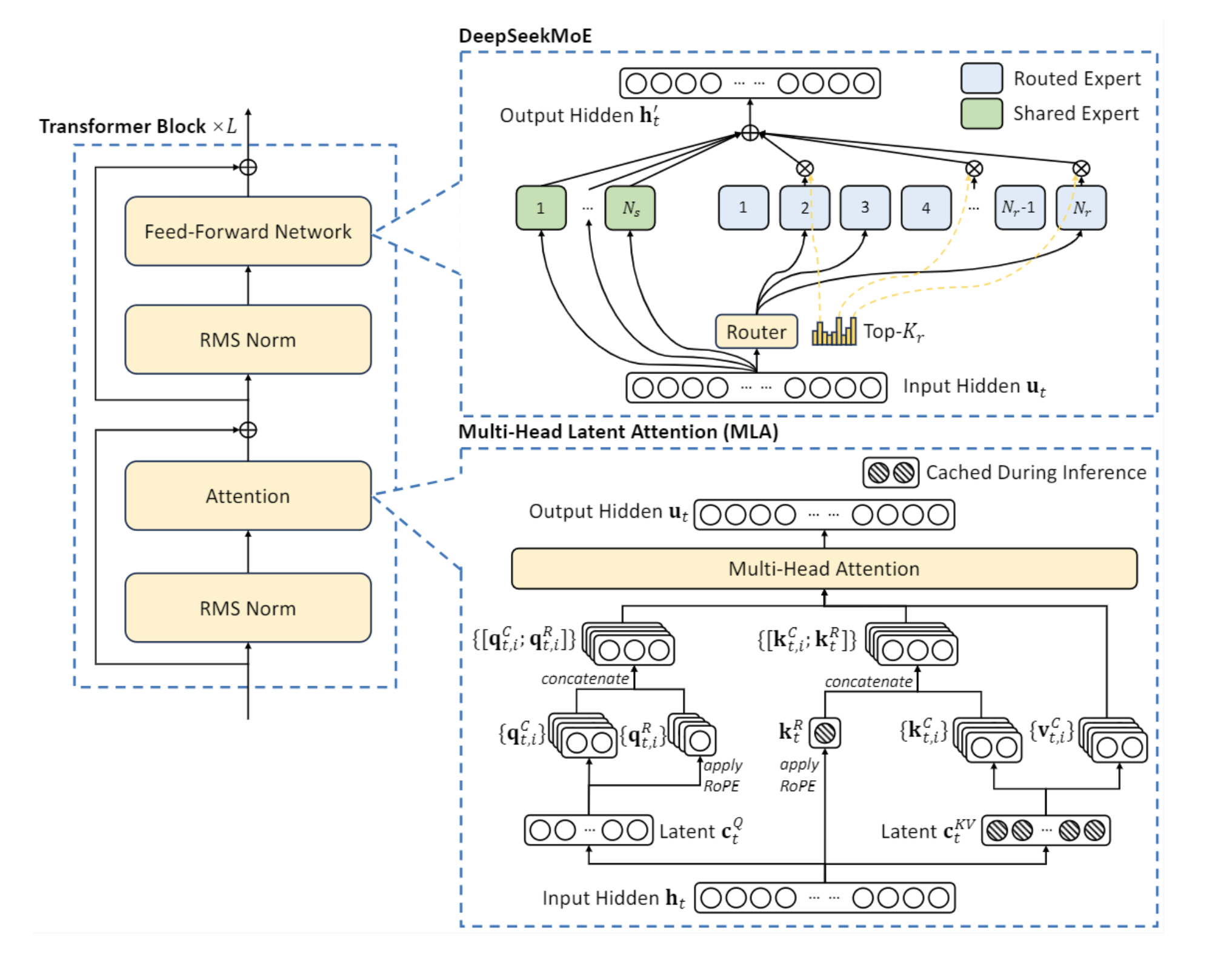
一些前置函数,主要是两个函数,一个 RMSNorm 的实现以及 ROPE 函数的实现,因为本次博客不涉及位置编码的解读,因此可以先简单把 ROPE 理解为一个函数,应用这个函数之后这部分张量(Tensor)就带有了位置编码的作用。
class DeepseekV2RMSNorm(nn.Module):
    def __init__(self, hidden_size, eps=1e-6):
        super().__init__()
        self.weight = nn.Parameter(torch.ones(hidden_size))
        self.variance_epsilon = eps

    def forward(self, hidden_states):
        input_dtype = hidden_states.dtype
        hidden_states = hidden_states.to(torch.float32)
        variance = hidden_states.pow(2).mean(-1, keepdim=True)
        hidden_states = hidden_states * torch.rsqrt(variance + self.variance_epsilon)
        return self.weight * hidden_states.to(input_dtype)

class DeepseekV2RotaryEmbedding(nn.Module):
    def __init__(self, dim, max_position_embeddings=2048, base=10000, device=None):
        super().__init__()

        self.dim = dim
        self.max_position_embeddings = max_position_embeddings
        self.base = base
        inv_freq = 1.0 / (
            self.base ** (torch.arange(0, self.dim, 2).float().to(device) / self.dim)
        )
        self.register_buffer("inv_freq", inv_freq, persistent=False)
        # 较小索引位置对应较低频率
        # 较大的索引位置有较高的频率

        # Build here to make `torch.jit.trace` work.
        self._set_cos_sin_cache(
            seq_len=max_position_embeddings,
            device=self.inv_freq.device,
            dtype=torch.get_default_dtype(),
        )
        self.max_seq_len_cached = None

    def _set_cos_sin_cache(self, seq_len, device, dtype):
        self.max_seq_len_cached = seq_len
        t = torch.arange(
            self.max_seq_len_cached, device=device, dtype=self.inv_freq.dtype
        )

        freqs = torch.outer(t, self.inv_freq.to(t.device))
        # Different from paper, but it uses a different permutation in order to obtain the same calculation
        emb = torch.cat((freqs, freqs), dim=-1)
        self.register_buffer("cos_cached", emb.cos().to(dtype), persistent=False)
        self.register_buffer("sin_cached", emb.sin().to(dtype), persistent=False)

    def forward(self, x, seq_len=None):
        # x: [bs, num_attention_heads, seq_len, head_size]
        if self.max_seq_len_cached is None or seq_len > self.max_seq_len_cached:
            self._set_cos_sin_cache(seq_len=seq_len, device=x.device, dtype=x.dtype)

        return (
            self.cos_cached[:seq_len].to(dtype=x.dtype),
            self.sin_cached[:seq_len].to(dtype=x.dtype),
        )

# Copied from transformers.models.llama.modeling_llama.rotate_half
def rotate_half(x):
    """Rotates half the hidden dims of the input."""
    x1 = x[..., : x.shape[-1] // 2]
    x2 = x[..., x.shape[-1] // 2 :]
    return torch.cat((-x2, x1), dim=-1)

# Copied from transformers.models.llama.modeling_llama.apply_rotary_pos_emb
def apply_rotary_pos_emb(q, k, cos, sin, position_ids, unsqueeze_dim=1):
    cos = cos[position_ids].unsqueeze(unsqueeze_dim)
    sin = sin[position_ids].unsqueeze(unsqueeze_dim)

    b, h, s, d = q.shape
    q = q.view(b, h, s, d // 2, 2).transpose(4, 3).reshape(b, h, s, d)

    b, h, s, d = k.shape
    k = k.view(b, h, s, d // 2, 2).transpose(4, 3).reshape(b, h, s, d)

    q_embed = (q * cos) + (rotate_half(q) * sin)
    k_embed = (k * cos) + (rotate_half(k) * sin)
    return q_embed, k_embed
最终的代码实现,主要通过代码的注释理解,以及对应的 B站视频讲解;原始代码实现位于: https://huggingface.co/deepseek-ai/DeepSeek-V2-Chat/tree/main
以下代码相对于官方代码实现进行了一些必要的精简,主要为了理解 MLA 算法的核心计算逻辑,对于部分工程实现进行了忽略。
from dataclasses import dataclass


@dataclass
class DeepseekConfig:
    hidden_size: int
    num_heads: int
    max_position_embeddings: int
    rope_theta: float
    attention_dropout: float

    q_lora_rank: int
    qk_rope_head_dim: int
    kv_lora_rank: int
    v_head_dim: int
    qk_nope_head_dim: int
    attention_bias: bool


class MLA(nn.Module):
    def __init__(self, config,):
        super().__init__()

        self.attention_dropout = config.attention_dropout
        self.hidden_size = config.hidden_size
        self.num_heads = config.num_heads

        self.max_postion_embeddings = config.max_position_embeddings
        self.rope_theta = config.rope_theta

        # 对应 query 压缩的向量, 在 deepseek v3 中, hidden_size 7168
        # 但是压缩后的 kv d_c= 512,压缩比例 1/14
        # q 的压缩为 1536 压缩比例 1/4.7
        # rope 部分是 64

        self.q_lora_rank = config.q_lora_rank
        # 对应 query 和 key 进行 rope 的维度
        self.qk_rope_head_dim = config.qk_rope_head_dim
        # 对应 value 压缩的向量
        self.kv_lora_rank = config.kv_lora_rank

        # 对应 每一个 Head 的维度大小
        self.v_head_dim = config.v_head_dim

        self.qk_nope_head_dim = config.qk_nope_head_dim
        self.q_head_dim = config.qk_nope_head_dim + config.qk_rope_head_dim

        self.q_down_proj = nn.Linear(
            self.hidden_size,
            self.q_lora_rank,
            bias=config.attention_bias,
        )
        self.q_down_layernorm = DeepseekV2RMSNorm(self.q_lora_rank)

        self.q_up_proj = nn.Linear(
            self.q_lora_rank,
            self.num_heads * self.q_head_dim,
            # 最终还需要做切分(split),一部分是 nope,一部分需要应用 rope
            bias=False,
        )

        # 同理对于 kv 也是一样的
        self.kv_down_proj = nn.Linear(
            self.hidden_size,
            self.kv_lora_rank + self.qk_rope_head_dim,
            bias=config.attention_bias,
        )
        self.kv_down_layernorm = DeepseekV2RMSNorm(self.kv_lora_rank)
        self.kv_up_proj = nn.Linear(
            self.kv_lora_rank,
            self.num_heads * (
                self.q_head_dim - self.qk_rope_head_dim + self.v_head_dim
            ), # 其中 self.q_head_dim - self.qk_rope_head_dim 是 nope 部分
            bias=False,
        )

        # 对应公式 47 行
        self.o_proj = nn.Linear(
            self.num_heads * self.v_head_dim,
            self.hidden_size,
            bias=config.attention_bias,
        )

        # 初始化 rope 的参数
        self.rotary_emb = DeepseekV2RotaryEmbedding(
            self.qk_rope_head_dim,
            self.max_postion_embeddings,
            self.rope_theta,
        )

    def forward(
        self,
        hidden_states: torch.Tensor,
        attention_mask: Optional[torch.Tensor] = None,
        position_ids: Optional[torch.LongTensor] = None,
    ) -> Tuple[torch.Tensor, Optional[torch.Tensor], Optional[Tuple[torch.Tensor]]]:
        """
        MLA (Multi-head Linearized Attention) forward pass
        """
        bsz, q_len, _ = hidden_states.size()

        # 1. Query projection and split
        q = self.q_up_proj(
            self.q_down_layernorm(
                self.q_down_proj(hidden_states)
            )
        )
        q = q.view(bsz, q_len, self.num_heads, self.q_head_dim).transpose(1, 2)
        q_nope, q_pe = torch.split(
            q,
            [self.qk_nope_head_dim, self.qk_rope_head_dim],
            dim=-1
        )

        # 2. Key/Value projection and split
        compressed_kv = self.kv_down_proj(hidden_states)
        compressed_kv, k_pe = torch.split(
            compressed_kv,
            [self.kv_lora_rank, self.qk_rope_head_dim],
            dim=-1
        )
        k_pe = k_pe.view(bsz, q_len, 1, self.qk_rope_head_dim).transpose(1, 2)
        kv = (
            self.kv_up_proj(self.kv_down_layernorm(compressed_kv))
            .view(bsz, q_len, self.num_heads, self.qk_nope_head_dim + self.v_head_dim)
            .transpose(1, 2)
        )
        k_nope, value_states = torch.split(
            kv,
            [self.qk_nope_head_dim, self.v_head_dim],
            dim=-1
        )

        # 3. Apply RoPE to position-dependent parts
        kv_seq_len = value_states.shape[-2]

        cos, sin = self.rotary_emb(value_states, seq_len=kv_seq_len)
        q_pe, k_pe = apply_rotary_pos_emb(q_pe, k_pe, cos, sin, position_ids)


        # 最终 Q, k, V 的 Shape 都希望是 (batch_size, num_heads, seq_len, head_dim)
        # 其中 q / k 的 head_dim = self.qk_nope_head_dim + self.qk_rope_head_dim
        # v 的 head_dim = self.v_head_dim

        # 4. Combine position-dependent and independent parts
        query_states = torch.empty(
            bsz, self.num_heads, q_len, self.q_head_dim,
            device=k_pe.device
        )
        query_states[:, :, :, :self.qk_nope_head_dim] = q_nope
        query_states[:, :, :, self.qk_nope_head_dim:] = q_pe

        key_states = torch.empty(
            bsz, self.num_heads, q_len, self.q_head_dim,
            device=k_pe.device
        )
        key_states[:, :, :, :self.qk_nope_head_dim] = k_nope
        key_states[:, :, :, self.qk_nope_head_dim:] = k_pe

        # 5. Compute attention scores
        attn_weights = torch.matmul(query_states, key_states.transpose(2, 3))
        attn_weights = attn_weights / math.sqrt(self.q_head_dim)

        if attention_mask is not None:
            attn_weights = torch.masked_fill(
                attn_weights,
                attention_mask == 0,
                float("-inf"),
            )

        # 6. Softmax and dropout
        attn_weights = F.softmax(
            attn_weights, dim=-1, dtype=torch.float32).to(query_states.dtype)
        attn_weights = F.dropout(
            attn_weights, p=self.attention_dropout, training=self.training)

        # 7. Compute attention output
        attn_output = torch.matmul(attn_weights, value_states)
        attn_output = attn_output.transpose(1, 2).reshape(bsz, q_len, -1)
        attn_output = self.o_proj(attn_output)

        return attn_output, attn_weights


# 写一个测试函数
def test_mla():
    config = DeepseekConfig(
        hidden_size=7168,
        num_heads=16,
        max_position_embeddings=1024,
        rope_theta=128000,
        attention_dropout=0.1,
        q_lora_rank=1536,
        qk_rope_head_dim=64,
        kv_lora_rank=512,

        v_head_dim=128,
        qk_nope_head_dim=128,
        attention_bias=False,
    )

    mla = MLA(config)
    x = torch.randn(2, 1024, 7168)
    position_ids = torch.arange(
        config.max_position_embeddings,
    ).unsqueeze(0).expand(
        x.size(0), -1
    )
    attn_output, attn_weights = mla(x, position_ids=position_ids)
    print(attn_output.shape)
    print(attn_weights.shape)


test_mla()
带有矩阵吸收的 MLA 算法
先参考这一篇知乎的解读: https://www.zhihu.com/question/655172528/answer/3492701118 ,之后我会做视频讲解